Why BETBY matters to players
BETBY is not a consumer sportsbook. It is a B2B supplier used by gambling operators to power sportsbook products. BETBY says its solution includes trading, risk management, client segmentation and reporting, with machine-learning and AI tools used across the product.
That distinction matters in complaints. A player may have an account with Operator A, but the sportsbook decision being communicated to the player can originate from, or be heavily influenced by, the underlying provider.
What the public record shows
Across the cases reviewed by CryptoBetGrade, BETBY is repeatedly named in disputes involving value betting, low-category events, arbitrage allegations, account flags and the cancellation or non-payment of sportsbook winnings. This does not mean every BETBY operator treats a flag in the same way.
| Case / operator | Publicly stated trigger | Reported consequence |
|---|---|---|
| Sherbet | Value bets + low-category events; prior flag elsewhere | Account suspension / disputed funds |
| Jackpotter | Systematic value / EV+ betting across wider provider data | Deposit returned; disputed profits not paid |
| Bitz.io | Player alleged a BETBY false-positive after two bets | 160 USDT dispute; thread later marked resolved |
| Rollbit | Provider flag triggered KYC in a public 2023 case | Separate geolocation/KYC issue then determined closure |
| Winna | Operator publicly referred to value/arbitrage betting / fraud-team classification | Winnings dispute |
The strongest conclusion the public material supports is therefore not “BETBY confiscates winnings.” Operators control their own customer terms and can react differently. The supported pattern is that BETBY-generated or BETBY-associated risk decisions appear repeatedly in public sportsbook disputes, while the financial consequence varies by operator.
Same provider, different operator outcome
This is the most important finding. In one Bitcointalk discussion, a participant explicitly contrasted BETBY-powered operators that allegedly limit and pay with operators that use provider flags as grounds to remove winnings. That claim is a forum participant's assessment, not an independently established industry rule, but it points to a distinction CryptoBetGrade tracks at operator level.
Provider signal
Risk model flags the account or betting pattern. The operator can investigate, request KYC, reduce limits or close future sportsbook access.
Operator consequence
The operator decides what its terms permit and what happens to accepted bets, winnings and the remaining account balance.
For players, this means knowing the provider is useful — but it is not enough. The operator's own history of responding to provider flags matters just as much.
Rollbit is a useful comparison point
Rollbit publicly identifies BETBY as its sportsbook provider in a 2023 dispute response. Its current Sports Policy also gives a specific definition of arbitrage: exploiting differences in odds across bookmakers or sportsbooks to guarantee profit. The stated consequence includes cancellation of bets and permanent restriction.
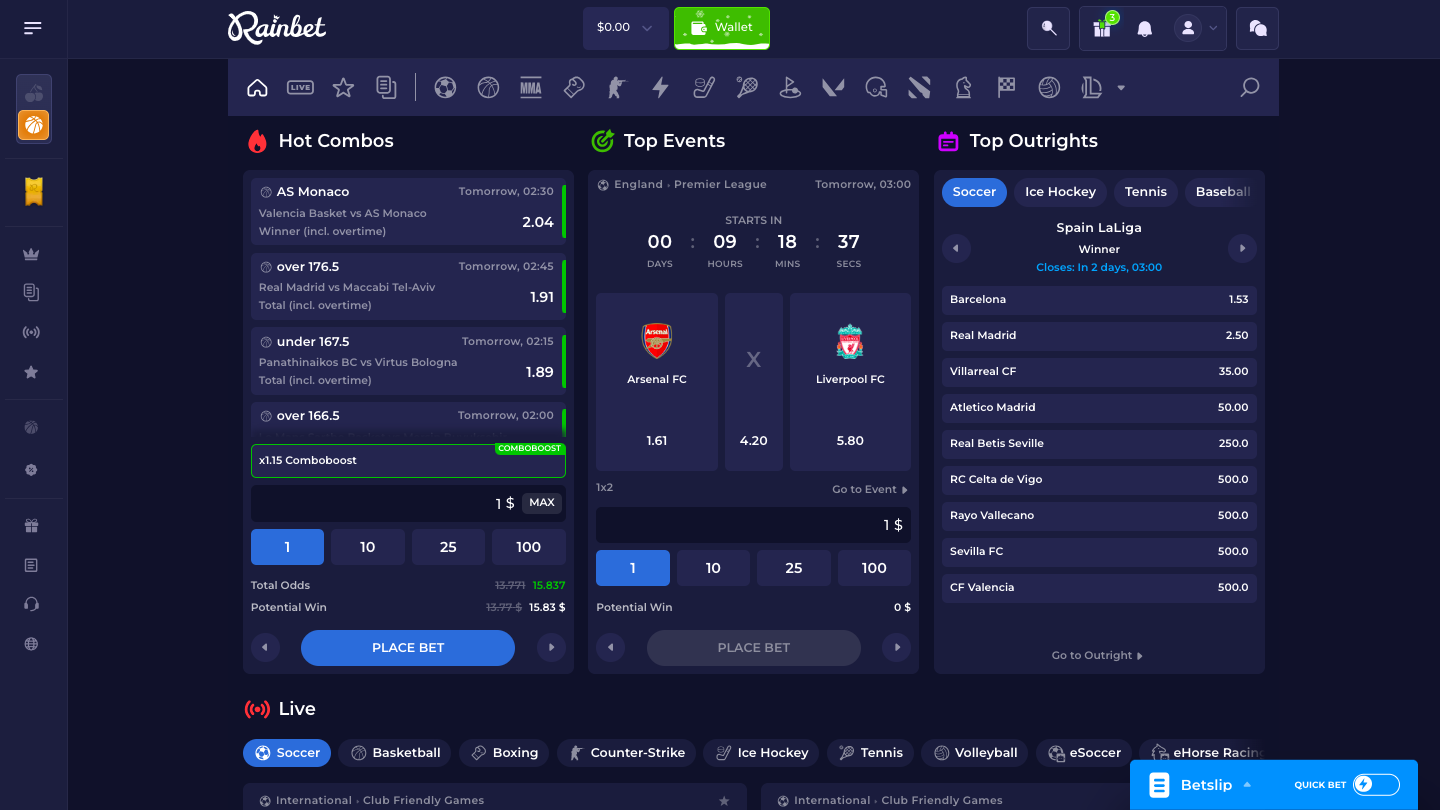
That wording provides a useful benchmark because it describes the prohibited strategy rather than simply using “arbitrage” as a generic label for profitable or +EV play. The image above shows a crypto sportsbook interface for illustrative context only — it is not evidence in any case discussed in this research.
What BETBY itself says about its role
BETBY describes its product as a complete sportsbook solution and says it handles sportsbook-related operations including risk management, trading, client segmentation and reporting. It also highlights AI and machine learning as part of its approach. In 2026 BETBY reported 47% year-on-year growth in active players across its partner network and a 21.2% increase in bets during the first half of the year.
Those statements help explain why provider-level analysis matters: a risk-management system deployed across many operators can potentially create recurring patterns that would be invisible if every complaint were viewed only as an isolated operator dispute.
What the data does — and does not — prove
The public record supports a recurring association between BETBY and risk flags involving value betting, low-category markets and other betting-pattern concerns. It also supports the conclusion that operators do not necessarily impose the same consequence after such a flag.
It does not establish that every disputed account was falsely flagged, that BETBY itself ordered every confiscation, or that all BETBY-powered sportsbooks share a single confiscation policy. Many cases expose only part of the communication between provider and operator.
CryptoBetGrade therefore records provider involvement separately from operator responsibility. As the dataset grows, the more useful question is not simply “How many BETBY complaints exist?” but which operators pay, limit, void or confiscate after a BETBY risk decision — and how transparent are they about why?
Sources
- BETBY Sportsbook — provider description of trading, risk management, segmentation and AI/ML functionality.
- BETBY H1 2026 update — network growth figures.
- Sherbet public dispute — operator statement attributing a value-betting/low-category flag to BETBY.
- Jackpotter public dispute — operator statement on value / EV+ betting across wider provider data.
- Bitz.io public dispute — player allegation concerning a BETBY false-positive; thread later marked resolved.
- Rollbit public dispute — Rollbit statement identifying BETBY as sportsbook provider.
- Rollbit Sports Policy — current arbitrage rule.
- Winna public discussion — operator/player statements around value/arbitrage classification.
See how complaint records like these feed into an operator's Trust Score.
How scoring works →